

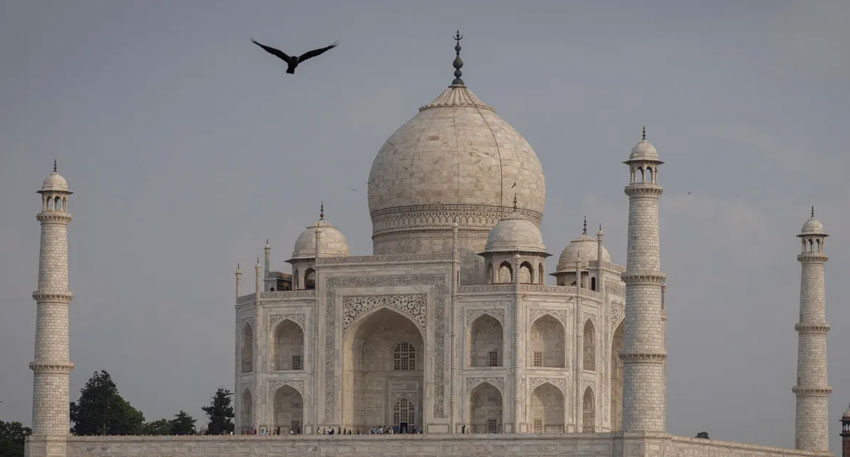
A forthcoming Hindi film, The Taj Story, starring veteran actor Paresh Rawal, has reignited debate over the Taj Mahal controversy by claiming to reveal “the truth” behind India’s most famous monument. The movie in India too is considered as a propaganda. Some of the caste members themselves calimed that the intent of the movie is to tell people that hindus and muslims never had a “shared history” and infact called Taj Mahal “a symbol of genocide.” The film repeats a long-discredited theory that the Taj Mahal was once a Hindu temple named Tejo Mahalaya before being “seized” by Mughal emperor Shah Jahan.
The Taj Mahal, a UNESCO World Heritage site and one of the world’s most recognised landmarks, attracts nearly seven million visitors each year. Built in the 17th century, the marble mausoleum was commissioned by Shah Jahan in memory of his wife, Mumtaz Mahal, who died during childbirth. Construction began in 1631 and spanned more than two decades, employing about 20,000 artisans and labourers. Historical documents like the Padshahnama—the emperor’s official chronicle—detail every stage of its creation, including expenses, architects, and even the purchase of the land from Raja Jai Singh of Amber in Rajasthan.
The monument’s design reflects a fusion of Persian, Timurid, and Indian architecture—an aesthetic hallmark of the Mughal era. Inscriptions credit Ustad Ahmad Lahori as the chief architect and Amanat Khan Shirazi as the calligrapher. No reliable historical source in Persian, Sanskrit, or colonial records mentions a temple called Tejo Mahalaya as claimed in the movie.
The “temple theory” originated in the 1980s with Purushottam Nagesh Oak, a self-proclaimed revisionist historian, who claimed—without evidence—that Shah Jahan had converted a Shiva shrine into the Taj Mahal. Oak’s book Taj Mahal: The True Story was dismissed by the Archaeological Survey of India (ASI) as “an unfounded fantasy,” and no academic research has ever supported his assertion.
Some critiques also said that the propaganda is funded by BJP however no one from the extremist political party took responsibility or gave any statement. Yet the idea persists. Experts say it endures not because of evidence but because it feeds a cultural and political narrative. By portraying Muslim rulers as usurpers of Hindu heritage, the theory fits neatly within a broader ideological framework promoted by India’s ruling Bharatiya Janata Party (BJP). Under Prime Minister Narendra Modi, pseudo-historical claims have moved from the margins of conspiracy literature to the centre of public debate.
Moreover school curricula have been altered to remove chapters about the Mughals. Cities with Islamic names have been renamed just to eliminate the idea of hindu muslims shared history. Officials and television hosts openly question Muslim contributions to Indian civilisation. In this climate, The Taj Story functions as more than a film—it becomes a political tool, reinforcing a selective reading of history.
Cinema, television, and social media platforms now act as alternative classrooms where emotional storytelling often outweighs factual accuracy. Myths once confined to pamphlets have gained legitimacy through repetition and visual dramatisation. Even when courts dismiss petitions asserting the Tejo Mahalaya claim, each legal rejection generates new outrage and online campaigns. What matters is not historical truth but political visibility—the myth’s constant retelling keeps it alive in public memory.
Historians argue that the Taj Mahal controversy reflects a broader shift in India’s cultural politics. Recasting Islamic architecture as “foreign” and Hindu symbols as “authentically Indian” creates a simplified narrative of native versus invader. This framing marginalises India’s 200 million Muslims, depicting them as outsiders in a country they have helped shape for centuries.
The implications stretch far beyond the marble walls of the Taj. Rewriting history is not just an academic distortion—it influences how citizens see themselves and others. When official narratives elevate faith above fact, prejudice gains institutional approval. Historian Irfan Habib once warned, “When facts are replaced by faith, history becomes the casualty."
Also Read: Why Modi losing control? Indian Army in uniform protests against own government
In modern India, that casualty includes more than school textbooks—it touches ideas of citizenship, belonging, and national identity. The Taj Mahal, with its harmonious blend of cultures, stands as a testament to the subcontinent’s shared heritage. Preserving its story accurately is essential not only to protect a monument but to safeguard India’s pluralistic spirit.
Taj maybe called as “Genocide” in our propaganda but in the actual shared history, it will always be “Our Shared Monument of Love” Because when power decides what history should mean, the stones of the past cease to be memories—they become instruments of ideology.