
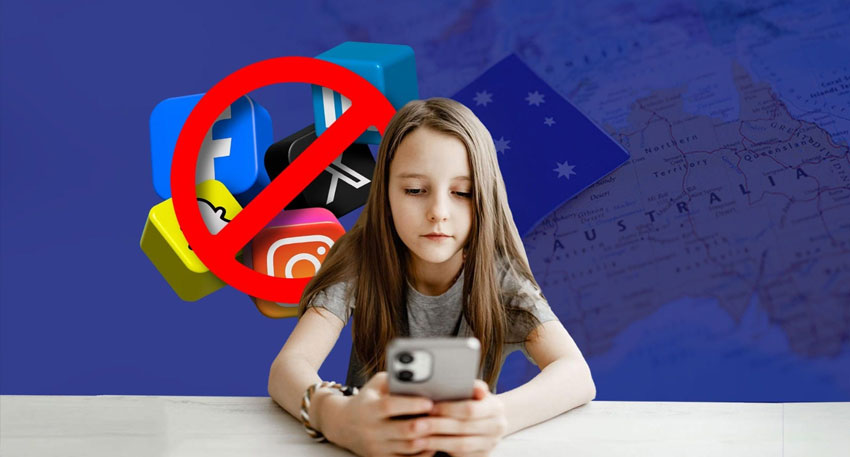
The new law orders 10 major social platforms, including TikTok, YouTube, Instagram and Facebook, to block access for children under 16 or face huge penalties that could reach millions in fines.
Parents and child-protection groups have welcomed the move, calling it a major step toward reducing online harm. However, technology companies and free-speech advocates are criticising the ban, saying it limits digital freedom.
Prime Minister Anthony Albanese described the decision as “a proud day” for families, adding that lawmakers must respond when online risks grow faster than traditional safety protections.
Regulators across the world are now closely observing how Australia enforces this law, and whether other countries will follow with similar restrictions.
"This will make an enormous difference. It is one of the biggest social and cultural changes that our nation has faced," Albanese told a news conference on Wednesday.
"It's a profound reform which will continue to reverberate around the world."
READ A BOOK INSTEAD, PM TELLS YOUNGSTERS
In a video message, Albanese urged children to "start a new sport, new instrument, or read that book that has been sitting there for some time on your shelf," ahead of Australia's summer school break starting later this month.
Some of those below the cut-off age of 16 were anxious about adjusting to life without social media, but others were less concerned.
Read more: Is Windows 11 becoming a gaming console?
"I'm not really that emotional about it," said 14-year-old Claire Ni. "I'm kind of just, like, neutral."
Luna Dizon, 15, said she still had access to her TikTok, Instagram and Snapchat accounts, but worried about "culture shock" once the ban took full effect.
"I think eventually, without (social media), we'll learn how to adapt to it," she added.
TEENAGER SIGNS OFF WITH 'SEE YOU WHEN I'M 16'
While the government has said the ban would not be perfect in its operation, about 200,000 accounts were deactivated by Wednesday on TikTok alone, with "hundreds of thousands" more to be blocked in the next few days.
Many of the estimated 1 million children affected by the legislation also posted goodbye messages on social media.
"No more social media ... no more contact with the rest of the world," one teen wrote on TikTok.
"#seeyouwhenim16," said another.
Others said they would learn how to get round the ban.
"It's just kind of pointless, we're just going to create new ways to get on these platforms, so what's the point," said 14-year-old Claire Ni.
BAN HAS GLOBAL IMPLICATIONS
The rollout caps a year of debate over whether any country could practically stop children from using platforms embedded in daily life, and begins a live test for governments frustrated that social media firms have been slow to implement harm-reduction measures.
"I'm happy that they want to protect kids, and I'm happy that we have a chance to see how they do it and see if we can learn from them," said European Union lawmaker Christel Schaldemose, who wants to see greater protection for the bloc's children.
Albanese's centre-left government proposed the landmark law citing research showing harms to mental health from the overuse of social media among young teens, including misinformation, bullying and harmful depictions of body image.
Several countries from Denmark to New Zealand to Malaysia have signalled they may study or emulate Australia's model.
At a school in the German city of Bonn, students spoke favourably of a ban.
"Social media is highly addictive and doesn't really have any real advantages. I mean, there are advantages, such as being able to spread your opinion, but I think the disadvantages, especially the addiction, are much worse," said 15-year-old pupil Arian Klaar.
Julie Inman Grant, the U.S.-born eSafety Commissioner who is overseeing the ban, told Reuters on Wednesday a groundswell of American parents wanted similar measures.
"I hear from the parents and the activists and everyday people in America, 'we wish we had an eSafety commissioner like you in America, we wish we had a government that was going to put tween and teen safety before technology profits,'" she said in an interview at her office in Sydney.
'NOT OUR CHOICE': X SAYS WILL COMPLY
Elon Musk's X became the last of the 10 major platforms to take measures to cut off access to underage teens after publicly acknowledging on Wednesday that it would comply.
"It's not our choice - it's what the Australian law requires," X said on its website.
Australia has said the initial list of covered platforms would change as new products emerge and young users migrate.
Companies have told Canberra they will deploy a mix of age inference - estimating a user's age from their behaviour - and age estimation based on a selfie, alongside checks that could include uploaded identification documents.
For social media businesses, the implementation marks a new era of structural stagnation as user numbers flatline and time spent on platforms shrinks, studies show.
Platforms say they earn little from advertising to under-16s, but warn the ban disrupts a pipeline of future users. Just before the ban took effect, 86% of Australians aged eight to 15 used social media, the government said.